

Most volleyball players spend time thinking about performance.
Far fewer spend time thinking about recovery.
Yet recovery is what allows your body to adapt to training, tolerate repeated games, and continue performing throughout the season.
Whether you’re playing recreationally once a week, competing in tournaments, or training multiple times per week, understanding recovery can help you feel better, reduce excessive soreness, and maintain performance over the long term.
What is Recovery?
Recovery is the process of restoring your body’s physical and mental capacity after activity.
During volleyball, your body experiences:
- Muscle fatigue
- Repeated jumping and landing forces
- Overhead shoulder loading
- Nervous system stress
- Energy expenditure
- Fluid loss
Recovery is simply the process of replenishing those resources.
The goal isn’t to eliminate all soreness.
The goal is to prepare your body for the next time you play.
The Recovery Hierarchy
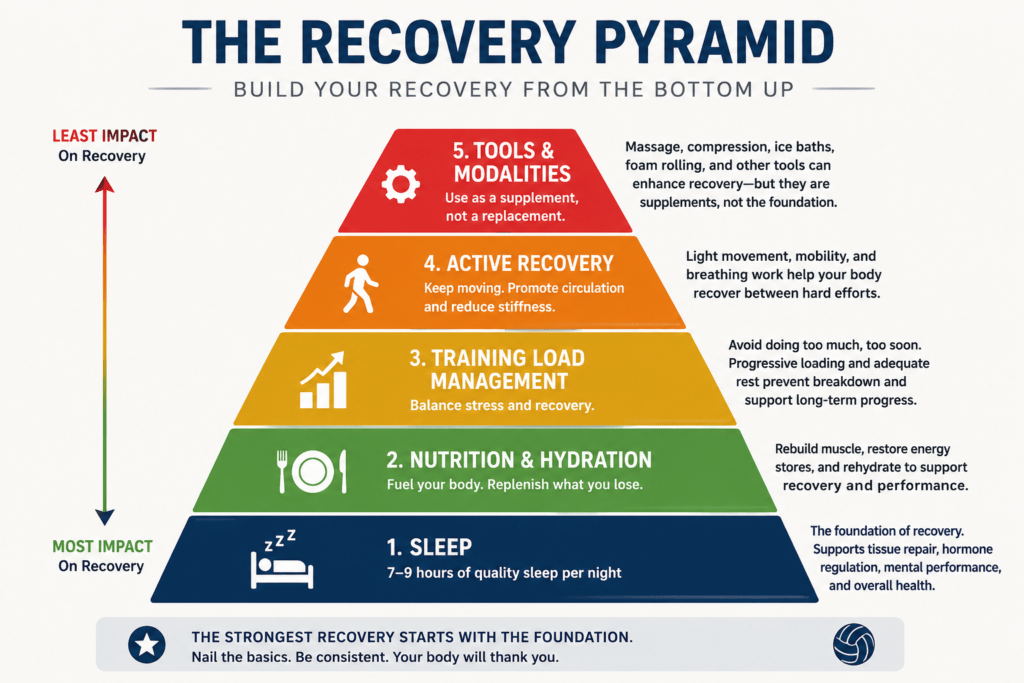
Not all recovery methods are equally important.
Think of recovery as a pyramid.
Level 1: Sleep
Level 2: Nutrition & Hydration
Level 3: Training Load Management
Level 4: Active Recovery
Level 5: Recovery Tools & Modalities
Many athletes spend money on Level 5 while neglecting Levels 1 through 3.
The fundamentals matter most.
1. Prioritize Sleep
If there is one recovery strategy supported consistently across sports science research, it is sleep.
Sleep plays a major role in:
- Muscle recovery
- Tissue repair
- Learning and skill development
- Hormonal regulation
- Reaction time
- Recovery from fatigue
Poor sleep is associated with:
- Reduced performance
- Increased fatigue
- Slower recovery
- Increased injury risk
General Recommendation
Aim for:
7–9 hours of sleep per night
Athletes with higher training volumes may benefit from even more.
Practical Tips
- Maintain a consistent sleep schedule
- Keep your room cool and dark
- Reduce screen exposure before bed
- Avoid large amounts of caffeine late in the day
2. Rehydrate After Play
Volleyball may not feel as demanding as endurance sports, but players still lose fluid through sweat.
Even mild dehydration can negatively affect:
- Performance
- Concentration
- Recovery
Practical Recommendation
After play:
- Drink water regularly
- Replace fluids lost through sweating
- Consider electrolytes during long sessions or tournaments
A simple check:
If your urine is consistently dark yellow after activity, hydration may need attention.
3. Refuel Your Body
Volleyball requires repeated bursts of high-intensity movement.
After activity, your body benefits from:
Protein
Supports tissue repair and recovery.
Examples:
- Greek yogurt
- Milk
- Protein shakes
- Eggs
- Meat
- Fish
- Tofu
Carbohydrates
Help replenish energy stores.
Examples:
- Rice
- Potatoes
- Fruit
- Oats
- Bread
A recovery meal containing both protein and carbohydrates is often a practical approach.
4. Keep Moving
One of the most misunderstood recovery concepts is the idea that complete rest is always best.
For most athletes, light movement can help reduce feelings of stiffness.
Examples:
- Walking
- Easy cycling
- Light mobility work
- Gentle stretching
The goal is not to create another workout.
The goal is to promote circulation and maintain movement.
5. Manage Your Weekly Load
Recovery isn’t just about what you do after a game.
It’s also about how much stress you place on your body throughout the week.
Common problems occur when:
- Playing volume increases rapidly
- Multiple tournaments occur close together
- Recovery opportunities decrease
- Sleep quality declines
Many overuse issues develop when the body’s recovery capacity cannot keep up with the demands being placed on it.
A good recovery strategy includes monitoring workload—not just treating symptoms afterward.
6. Take Care of Common Volleyball Stress Areas
Shoulders
Volleyball involves repeated overhead hitting and serving.
Helpful strategies include:
- Shoulder mobility work
- Rotator cuff strengthening
- Scapular control exercises
- Managing excessive overhead volume
Knees
Jumping and landing place substantial stress on the knees.
Helpful strategies include:
- Progressive strength training
- Managing jump volume
- Recovery between high-volume sessions
- Maintaining lower-body strength
Ankles
Ankles absorb significant landing forces.
Helpful strategies include:
- Balance training
- Calf strengthening
- Ankle mobility work
- Progressive return after sprains
Low Back
The low back is frequently stressed by rotation, extension, and repeated jumping.
Helpful strategies include:
- Maintaining hip mobility
- Strength training
- Managing cumulative workload
- Regular movement throughout the day
What About Ice Baths, Massage Guns, and Recovery Gadgets?
Many recovery tools may help athletes feel better.
Examples include:
- Massage
- Foam rolling
- Massage guns
- Compression boots
- Cold water immersion
Some research suggests these methods may help reduce perceived soreness and improve recovery experience.
However, they should be viewed as supplements—not replacements—for the fundamentals.
Remember the recovery hierarchy:
Sleep, nutrition, hydration, and load management remain the foundation.
A Simple Post-Game Recovery Checklist
After playing volleyball:
✓ Rehydrate
✓ Eat a protein-containing meal
✓ Include carbohydrates
✓ Get a good night’s sleep
✓ Perform light movement the following day
✓ Monitor recurring soreness or stiffness
✓ Manage weekly training and playing volume
The Bottom Line
The best recovery strategies are often the least exciting.
Before investing in the newest recovery gadget, focus on the fundamentals:
- Sleep
- Hydration
- Nutrition
- Load management
- Consistent movement
These habits form the foundation of long-term performance, recovery, and durability.
Recovery isn’t about doing more.
It’s about giving your body what it needs to be ready for the next opportunity to play.

Richard Lam
Richard is the owner of Vital Wellness centre and practices as a registered massage therapist with a specialty in therapeutic massage, utilizing techniques including manual therapy, contemporary medical acupuncture and exercise therapy.